Algemetric
- AI
- data security
- product discovery
Decision builder
TLDR:
I know you don’t have time to read a whole portfolio, so here’s what matters:
- ChallengeAlgemetric's Multiparty computation (MPC) technology didn't have product-market fit yet. With annual planning coming up, we had one month to conceive a product with MPC that made a possible future for the technology tangible, to present to investors. — Go to section: The challenge
- My role & scopeDesign the concept, through discovery, alignment with engineers, data analysts and business developers, desk research and the prototype. — Go to section: Discovery
- ResultsAfter the concept was presented to investors, new topics became priorities in the next year's strategy: integrations with other tools, natural language, and bringing MPC into products companies already use. — Go to section: The results
- Key decisions & trade-offsPosition the product as decision support, not a security tool. Set it apart from generic LLMs with a structured decision method instead of a chat. Answer the fear of leaks with an AI that never accesses the real data. Keep accountability with the decision-maker, who can review and change every factor. — Go to section: Product definitions
The problem
Overview
Algemetric is a US company doing advanced research in cryptography, specializing in secure, privacy-preserving data analytics. It's the younger sibling of Symetrix, a research company that earns revenue from semiconductor patent royalties.
The idea was to replicate that model in software, with Multiparty computation (MPC) as the core innovation: data stays encrypted and distributed across multiple databases, and computations run without decrypting it.
The Decision builder was an innovation initiative that influenced the company's strategic plan and brought investors into the discussion about the product's future.
MPC in plain words
MPC runs calculations on encrypted data without ever exposing the data.
Without MPC
An analyst running HR reports can open the whole salary table and see what a colleague earns. If the company gets hacked, all of it is exposed.
With MPC
Data is encrypted and split across cloud services like AWS and Google Cloud. A breached database only gives away meaningless pieces.
With extra privacy measures
Sensitive columns return only aggregates. You can calculate the average salary, but never see one person's. The result is decrypted only with your own key.
Where design comes in
While mathematicians and cryptographers developed the technology, my job was to find out which real problems it could solve, through product discovery, user research and creative methods.
Usually you find the problem first and then build the technology. Here it was the other way around: the technology existed, and the problem was missing. Many tech companies started like this, as research labs.
The challenge
Algemetric had a product, Prisma, but was still looking for product-market fit. In that context, the CEO set a challenge with a one-month deadline.
Prisma
Algemetric's dashboard builder, which generates charts from encrypted data. It served to validate MPC and bring in revenue, with clients in oil, hospitality and debt collection.
Product-market fit
Security alone was hard to sell. Large companies value it but are slow to adopt new processes. Small businesses focus on day-to-day operations and often lack resources for data analysis.
One month
For the Annual Strategy Council, the CEO challenged design to conceive a product where MPC was essential. The concept had to show long-term potential, without being bound by current technical limits.
Design process
Discovery
With a tight deadline, the discovery brought software engineers, a data analyst and business developers together around a CSD matrix (certainties, suppositions and doubts), to map the data journey, from generation to the final decision.
A benchmark of business analytics and generative AI tools completed the map. BI tools like Power BI, Looker, Qlik Sense and Tableau made visualization intuitive, but stopped there. ChatGPT and Gemini handled tables and data preparation well, but deeper analysis depended on the user's expertise. Between them sat a gap: the decision itself.
That was the landscape in 2023, and it has changed since. There were no standards yet like MCPs, to connect AI to external data sources, or skills, for AI to follow structured processes.
Competitors' gaps
In 2023, the data and AI tools companies used had four gaps.
Visualization only
Lots of charts, little support for turning insights into concrete decisions.
Unauthorized data use
Large companies banned generative AI internally, fearing model training on, or misuse of, sensitive data.
Accountability
When AI suggests a course of action, who answers for the outcome? Accuracy disclaimers don't solve it.
Little guidance
Generic LLMs give few actionable steps to people who don't know decision-making methods.
Desk research
Desk research showed why deciding with data is still hard, and what a tool should do about it.
Data overload
The volume and complexity of data make decisions inefficient. In a Gartner survey, 79% of corporate strategists said AI, automation and analytics would be essential over the next two years.
Cognitive fatigue
A study on judicial decisions found harsher sentences toward the end of the day. Tools can help decision-makers stay consistent when they're tired or short on time.
Decision vs. choice
Howard Rachlin separates the decision (the thinking) from the choice (the action). The concept focuses on supporting the decision, so people feel more confident about their choices.
Product definitions
Since security alone didn't sell, the concept shifted to helping people decide, with one guarantee: the AI works without accessing real data. Three definitions came from that.
A decision method
The differentiator is a structured, AI-powered decision process, not another conversational AI. It guides even people who don't know how to frame the decision.
Encrypted data
In 2023, companies like Amazon and Apple restricted AI tools over fear of leaks. With MPC, not even Algemetric can access a client's raw data.
Support, with control
The tool doesn't decide for anyone. At every step, people can review, understand and change the factors, so accountability stays with the decision-maker.
Experience
Follow-up questions
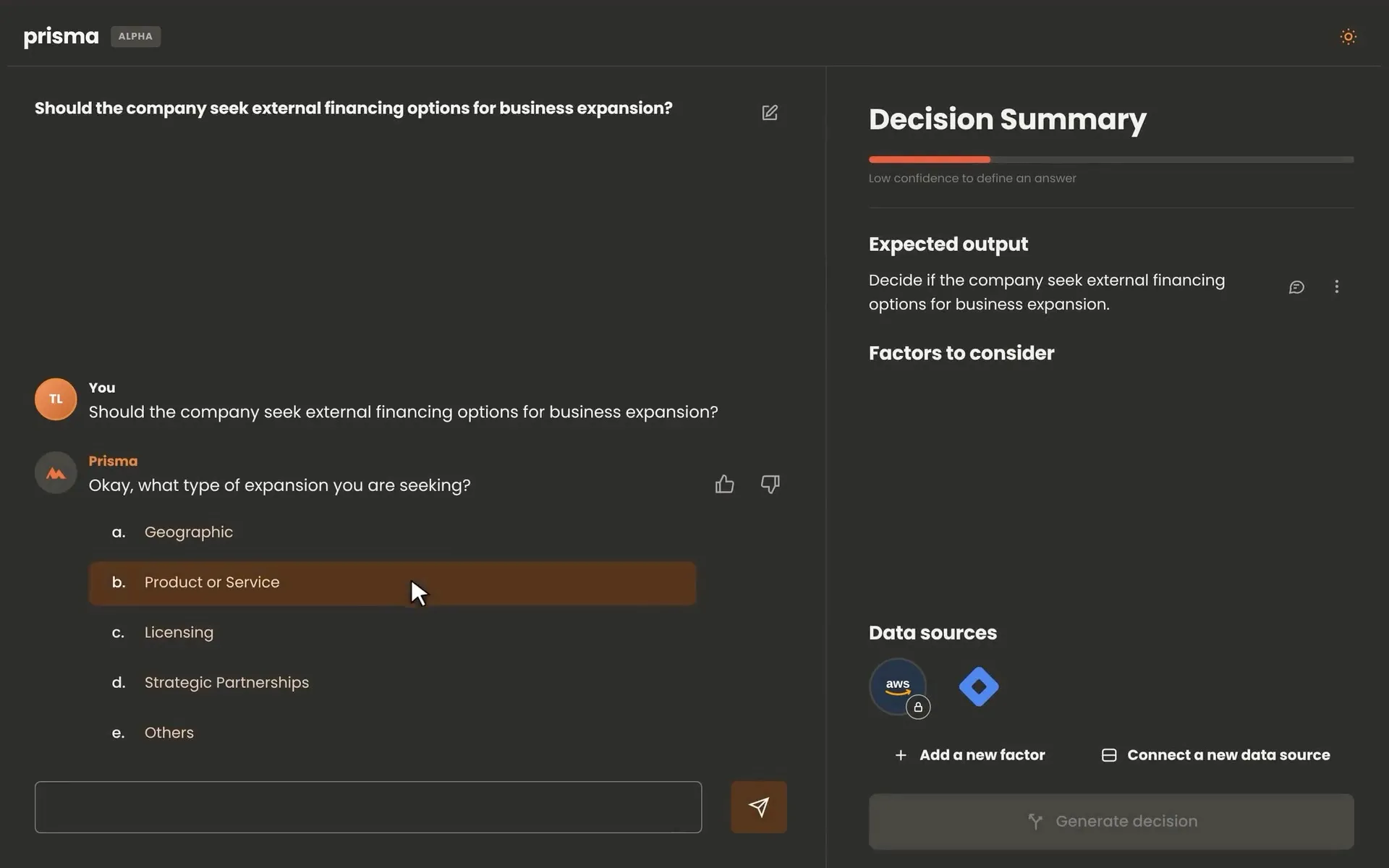
Instead of answering the first prompt as it is, the decision builder asks follow-up questions to refine it. People who don't know how to write the best prompt still get a clear, specific answer.
Meanwhile, a decision summary builds up on the side: the expected outcome and the factors to consider.
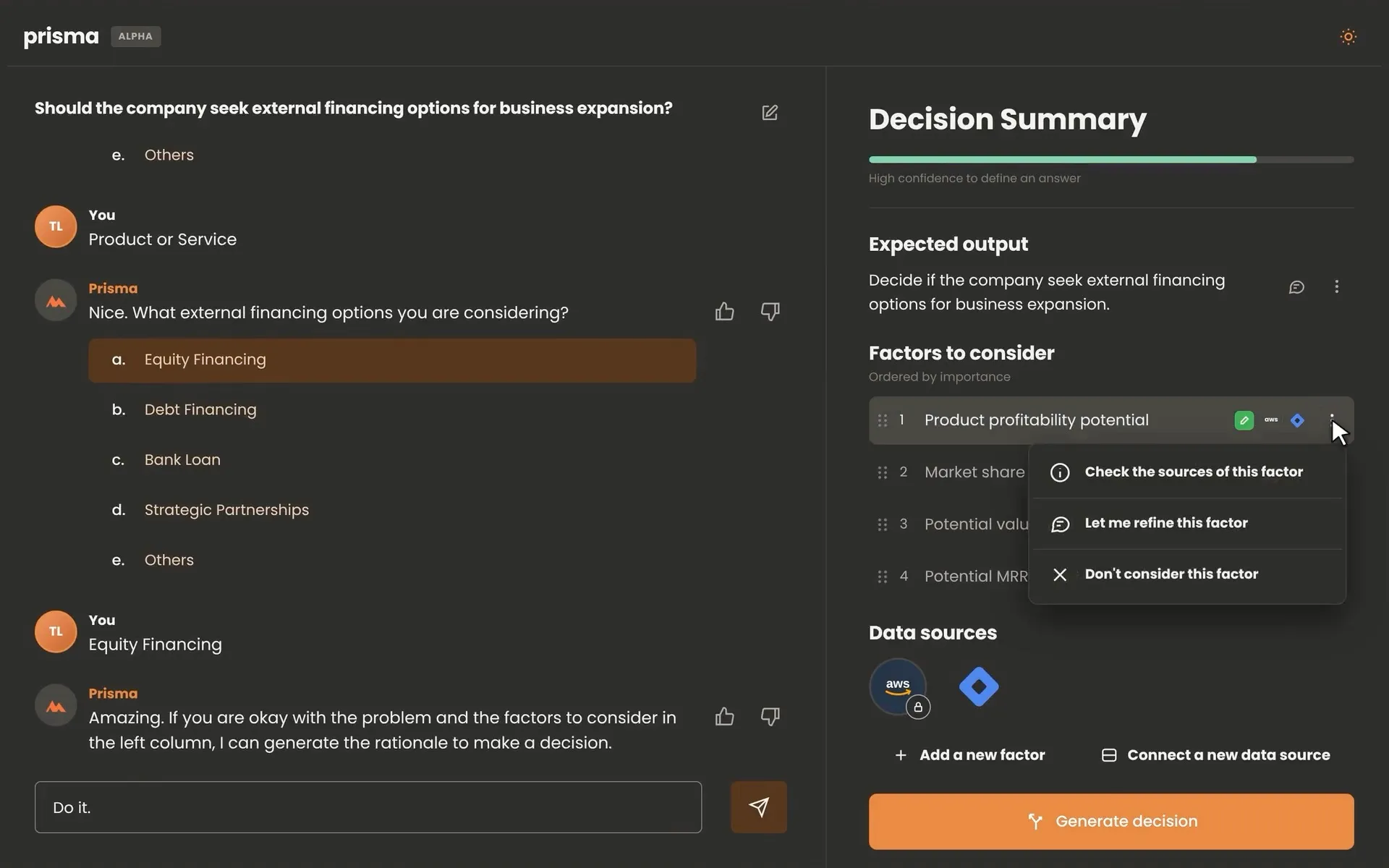
Factors and data sources
- Factors to consider: people can review the factors the AI suggests, add new ones, check each factor's data sources and reorder them by importance.
- Encrypted or not: encryption is costly to process, so each person chooses which sources need it, and can combine them with the tools they already use.
- Confidence level: a bar shows whether there's enough information to decide. People can still ask for a decision at any time, staying in control.
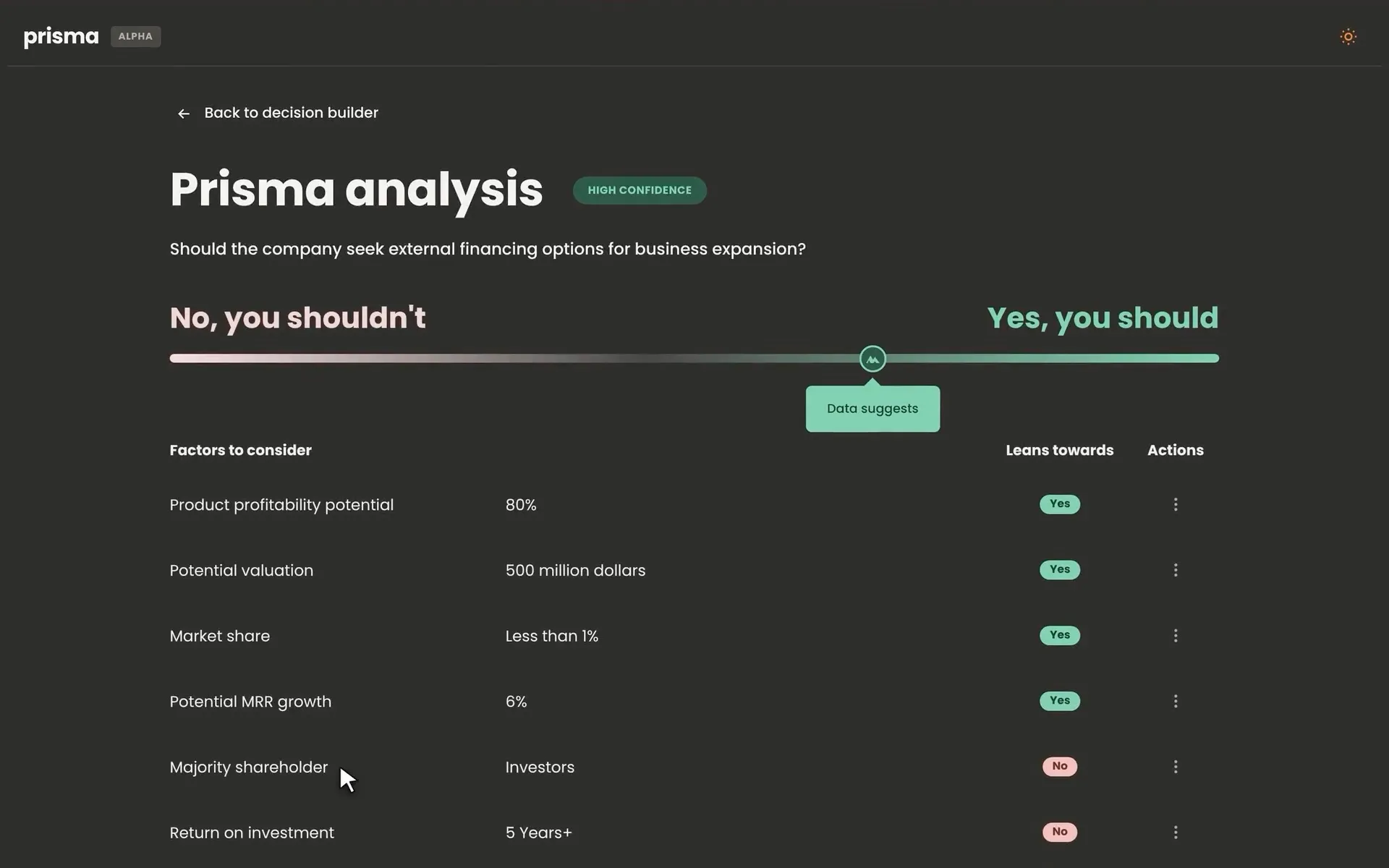
Review and decide
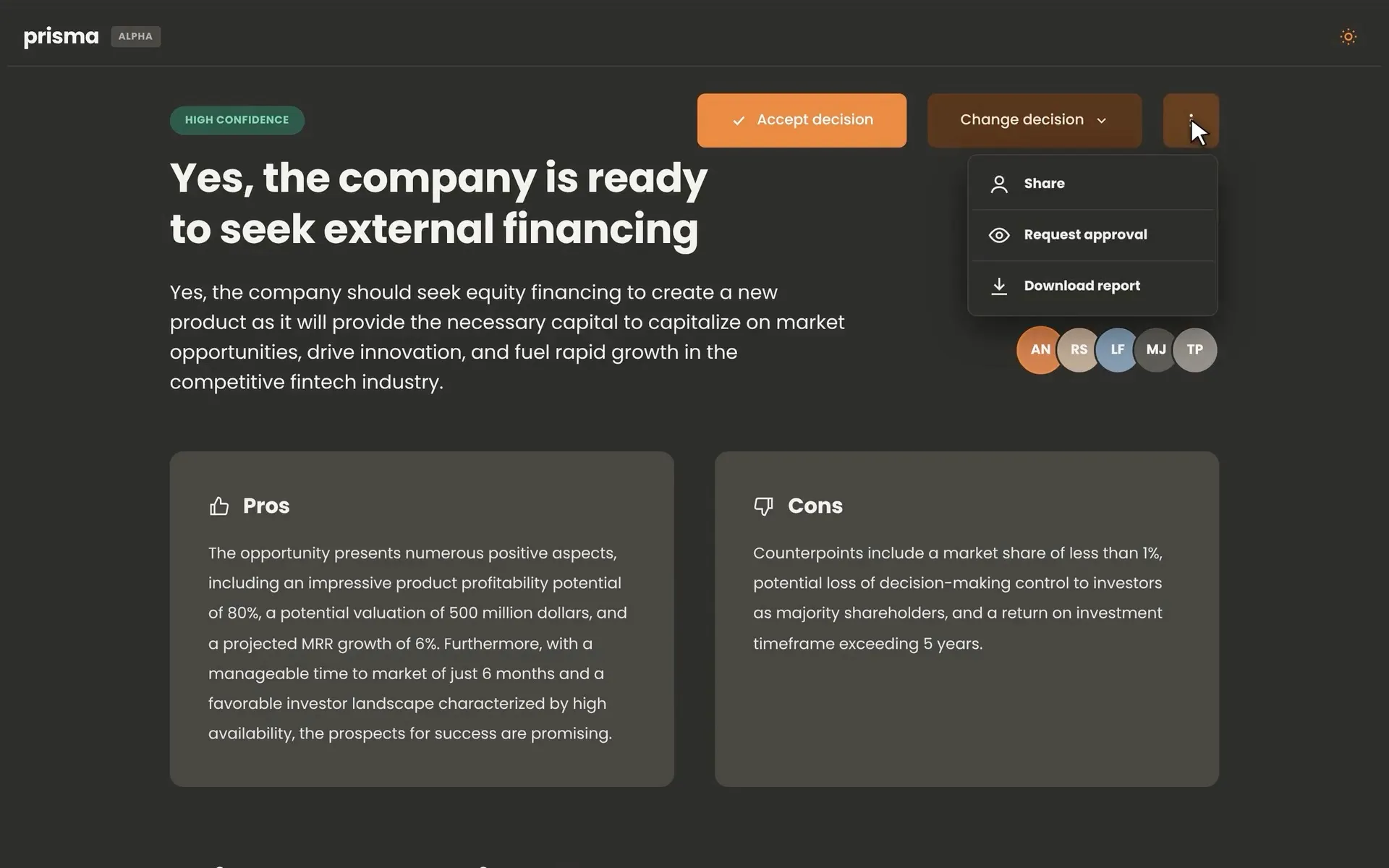
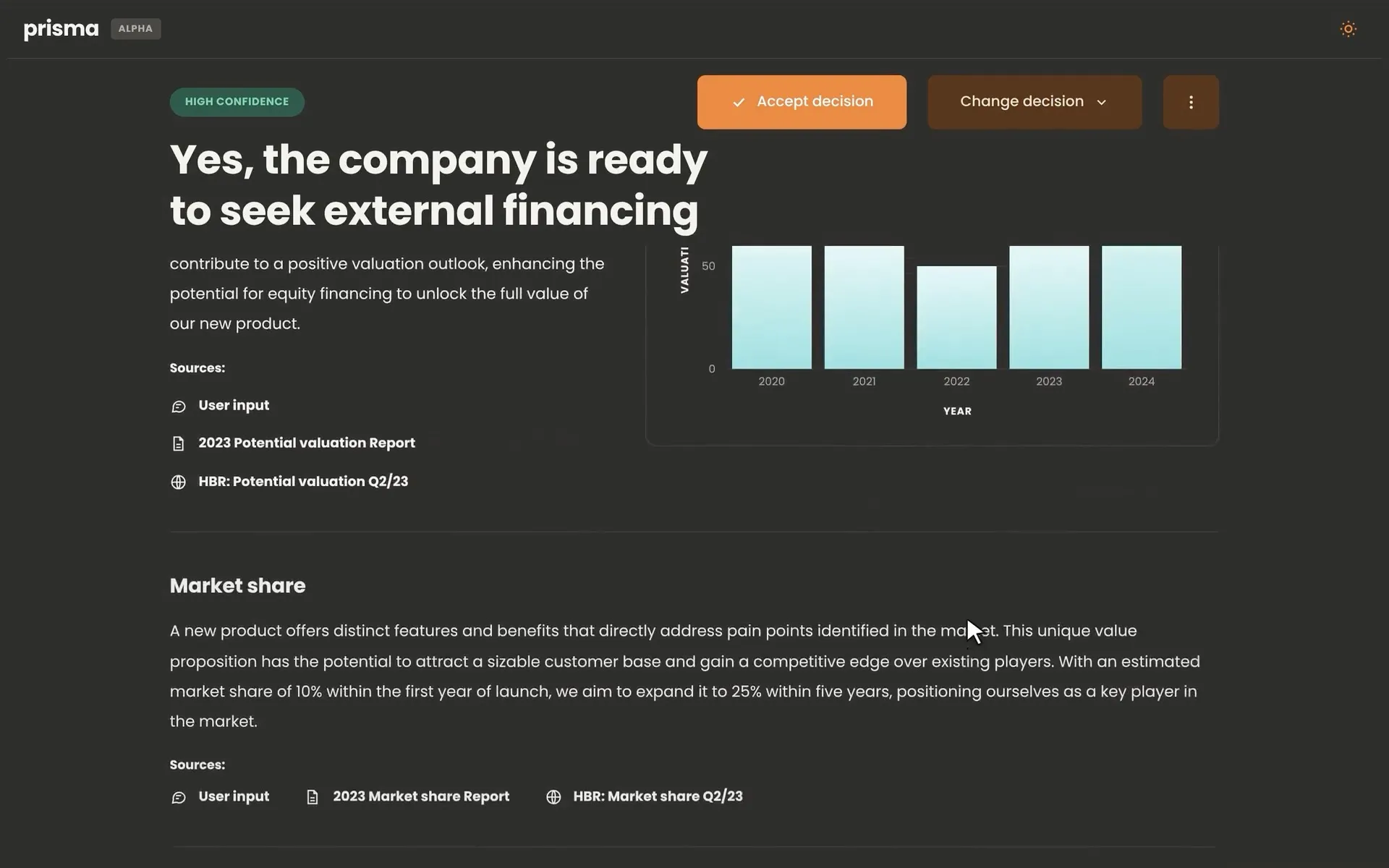
Before the full report, a summary shows how each factor pushed the outcome, positively or negatively.
Even when the AI suggests a result, people can choose differently. When they do, the system reframes the data to explain the alternative decision: pros become cons and vice versa.
The decision report
Result
The results
The concept, presented to investors at the Annual Strategy Council, changed the roadmap, the research and how MPC is sold.
First steps in AI
Investors showed interest in AI. The research team set up a group on AI forecasting, and Prisma started generating SQL from natural language to build charts.
External data sources
Combining encrypted data with other sources engaged investors most. The first quarter of the roadmap focused on integrations: database connectors, a smart API connector and two custom ones.
Prototyping to plan
The business development team came to see the prototype as a fast, low-cost way to plan and sell ideas, and asked for future concepts to be presented the same way.
Selling MPC
Investors saw MPC as a technology that enables other products, not as the main feature of a product. That opened a new business development front: an API to bring MPC to companies that already have established products and need security.
Key learnings
A design artifact goes beyond development. The concept worked as an alignment tool: it made a possible future concrete and made it easier for investors to understand and decide, which is exactly what the product proposes.
In 2026, three years later, the concept looks like what AI decision tools do, such as AI Council, and skills and agents that structure the decision process. It also anticipated patterns that became common: AI integrations with external data sources, like MCPs (Model Context Protocol), follow-up questions before answering, and predefined processes for tasks, like skills. For a concept meant to show long-term potential, the direction held up.