Oppizi
- marketplace
- B2B self-service
- fast delivery
Insert marketing
TLDR:
I know you don’t have time to read a whole portfolio, so here’s what matters:
- ChallengeConceive, in a few weeks, the acquisition flow of a marketplace where advertisers put flyers inside other companies' packages, and help product leadership with the business definitions. — Go to section: The challenge
- My role & scopeLead design in the war room: organize the team's hypotheses, design the end-to-end flow and ensure the handoff with developers. — Go to section: War room
- ResultsEnable commercial partnerships by using the prototype in negotiations, which made it possible to launch a new sales channel in a few months, now in several countries, with affiliates like JCPenney, Chewy and Ulta Beauty. — Go to section: The results
- Key decisions & trade-offsCut development and learning time by reusing the other channels' purchase flow. Let advertisers simulate the cost of targeting before checkout, making the offer flexible and transparent. Keep design from blocking the purchase, with a "Design later" option. — Go to section: Product definitions
The problem
Overview
Oppizi is a US offline marketing platform: flyering, direct mail and door to door, with campaigns bought and tracked online. Insert marketing was a new channel, different from the others because it didn't depend on an Oppizi team on the street.
The vision came from leadership, who spotted the opportunity early. As with any new product, there was no usage data and no direct references yet. The job was to make that vision concrete, fast.
Insert marketing in a nutshell
Insert marketing means putting one brand's flyer inside another brand's package. Oppizi wanted a marketplace for it.
Advertisers
Brands that want to reach new customers with coupons and flyers, paying less than with their own distribution.
Affiliates (shippers)
E-commerce companies that already ship packages and earn extra revenue by putting another brand's flyer inside.
The marketplace
Oppizi connects both sides and handles the rest: prints the inserts, ships them to affiliates and tracks results. The flyer reaches someone who just bought online.
Where design comes in
I already knew Oppizi's other purchase flows, so I knew what could be reused and what had to be new. My role was to give shape to leadership's vision, so that engineering, operations and sales could discuss the same product.
The challenge
Many open definitions, two audiences to serve and little time.
A new product
Price per affiliate or dynamic? Which audience filters could affiliates actually meet? How would approval work? The team decided this alongside design, and the screens helped decide.
Two sides at once
A marketplace only works with supply and demand. Affiliates had to come in first so advertisers had something to buy.
Speed
With little direct competition, being first was an advantage. The strategy was lean: design the experience in a week and start development right after.
Design process
War room
The project ran as a war room, with product, engineering, operations and leadership at the same table. While the technical team worked out how to track a flyer inside a package (with QR codes on the flyer and the package, without changing existing logistics), I designed the flow the advertiser would go through.
Both fronts moved together: every rule that came up in the technical discussion became a screen, and every screen raised a new question for the technical discussion.
Hypotheses and questions
I organized the project into hypotheses and questions to answer, to separate what needed validation in the pilot from what could be decided right away.
- Journey by moments: setup (sign-up), "aha" (seeing the value of targeting and budget) and habit (repeating and optimizing campaigns), for both advertiser and affiliate.
- Questions for the pilot: quality of affiliates' audience data, campaign tracking, pricing model, approval criteria and consumer privacy.
- Open questions, with a proposal: I brought the format, pricing and filter questions to the team, each with a proposal, like limiting formats to reduce friction.
Competition
The main competitor we mapped, in the UK, served large brands with many insert types, but had no self-service experience at all. That was the space Oppizi could take.
Product definitions
Each definition aimed to reduce effort on both sides of the marketplace.
Reuse what already works
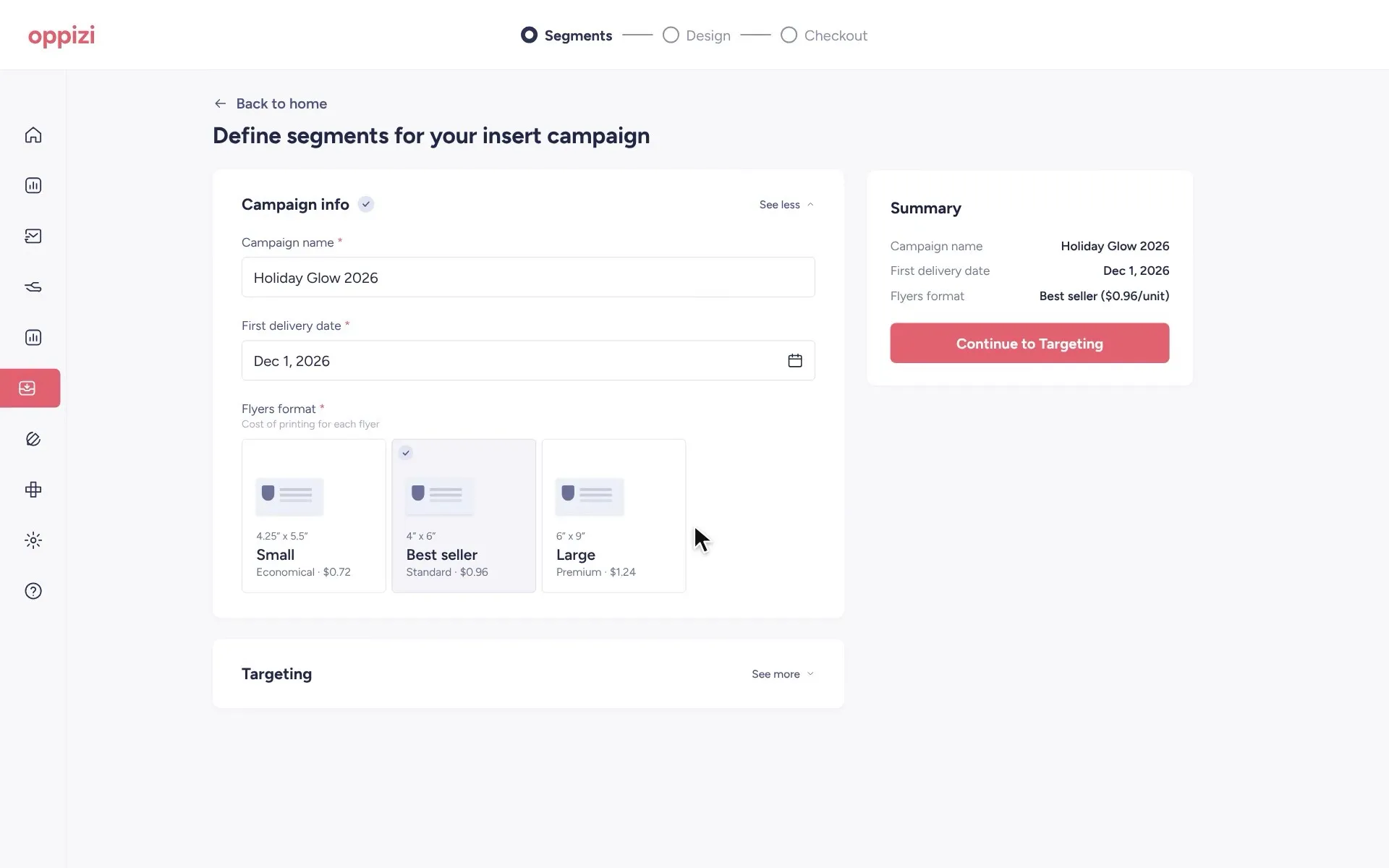
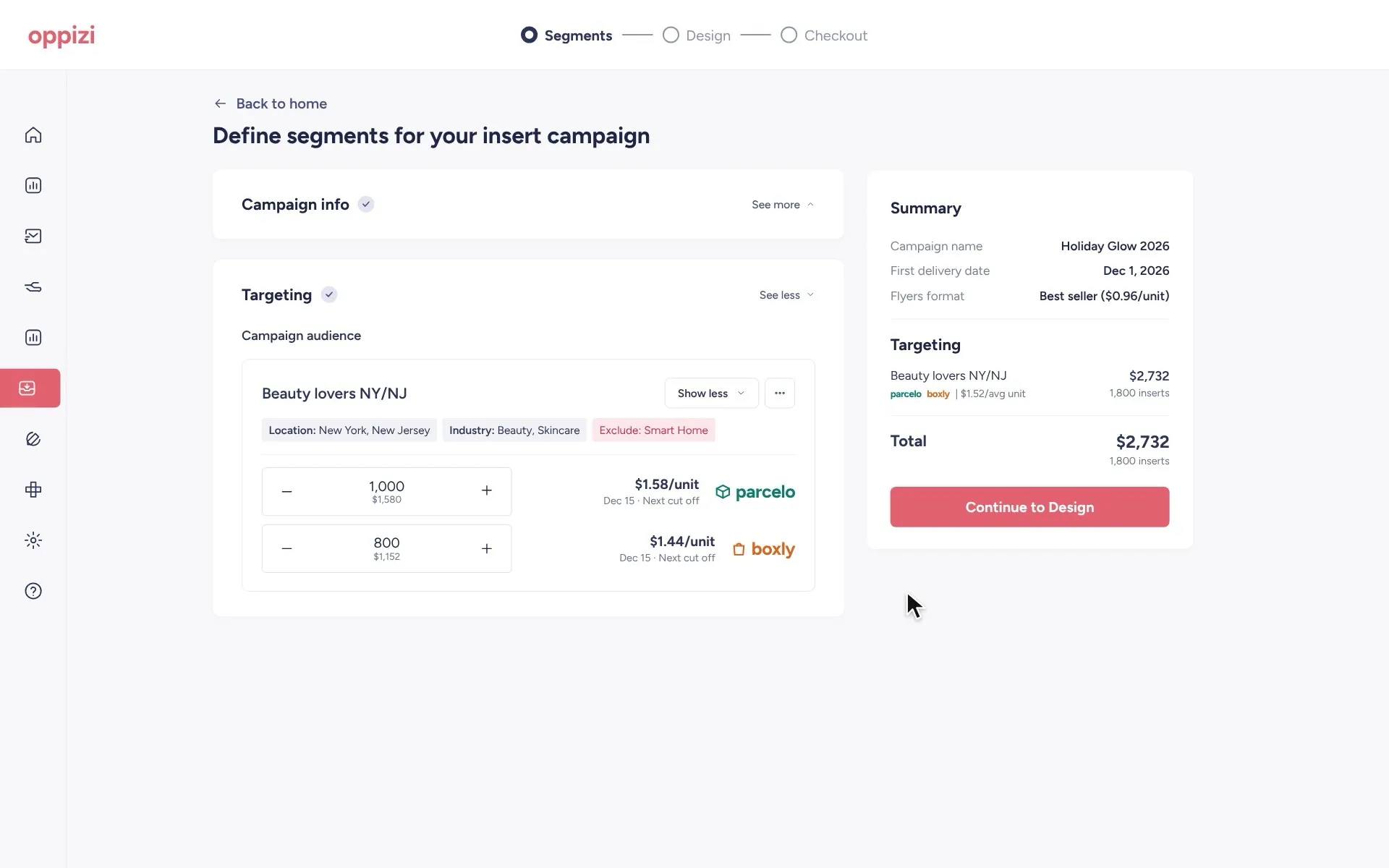
The flow follows the purchase structure of Oppizi's other channels: segments, design and checkout, with an always-visible summary. Less new to learn and less new to build.
Three formats
Instead of every possible insert size, I proposed three: economy, best seller and premium. Fewer decisions for the advertiser, less variation for the affiliate.
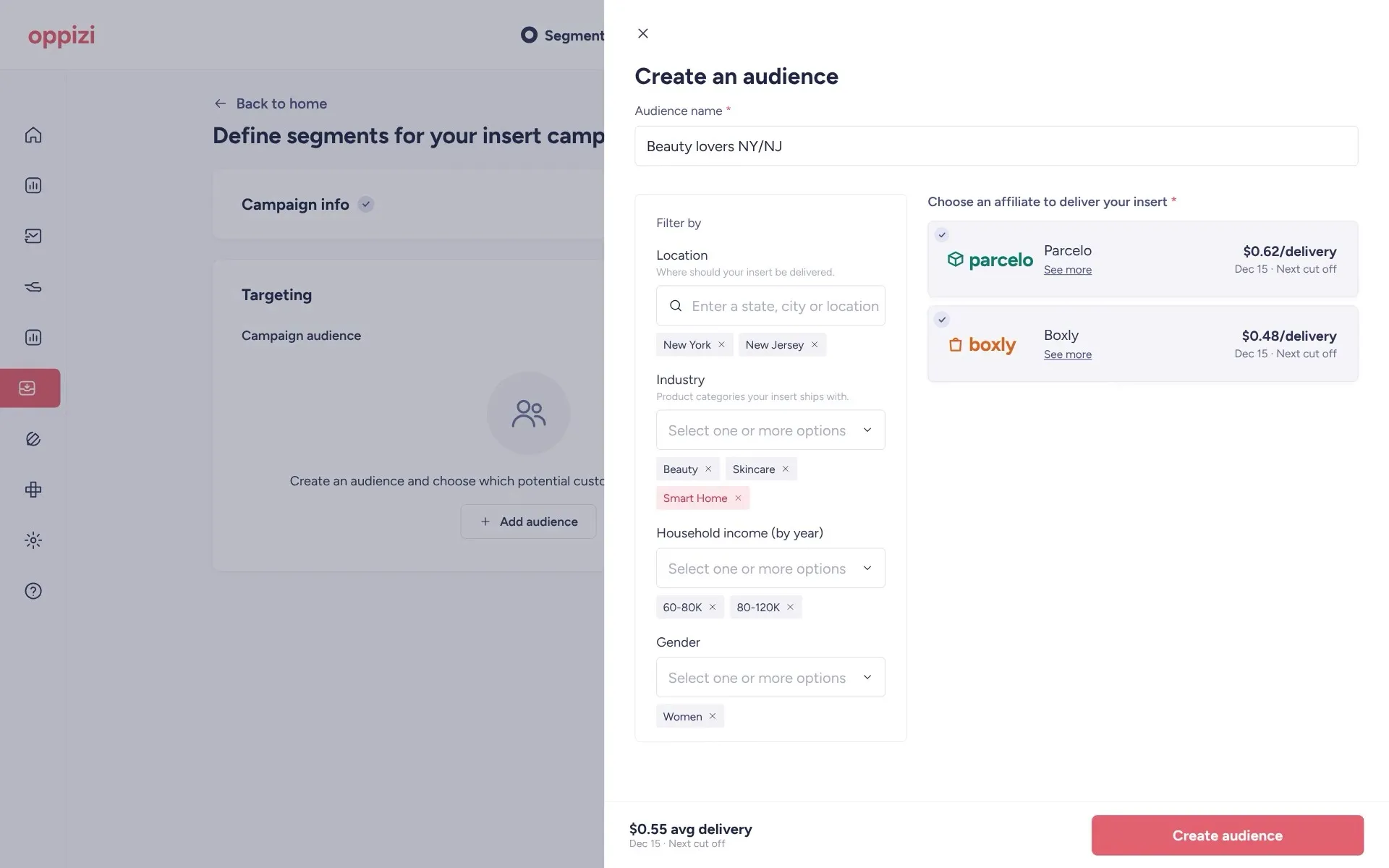
Price while choosing
The cost per delivery changes with every filter and shows on each affiliate's card. Advertisers understand the impact of targeting before reaching checkout.
Exclude, not just include
Besides choosing where and to whom to deliver, advertisers can exclude product categories, so the flyer doesn't land inside a competitor's package.
Controlled access
The channel isn't open to everyone. Advertisers request access and are approved by sales, and an affiliate never shows up as a delivery option for its own campaign.
Experience
Result
The results
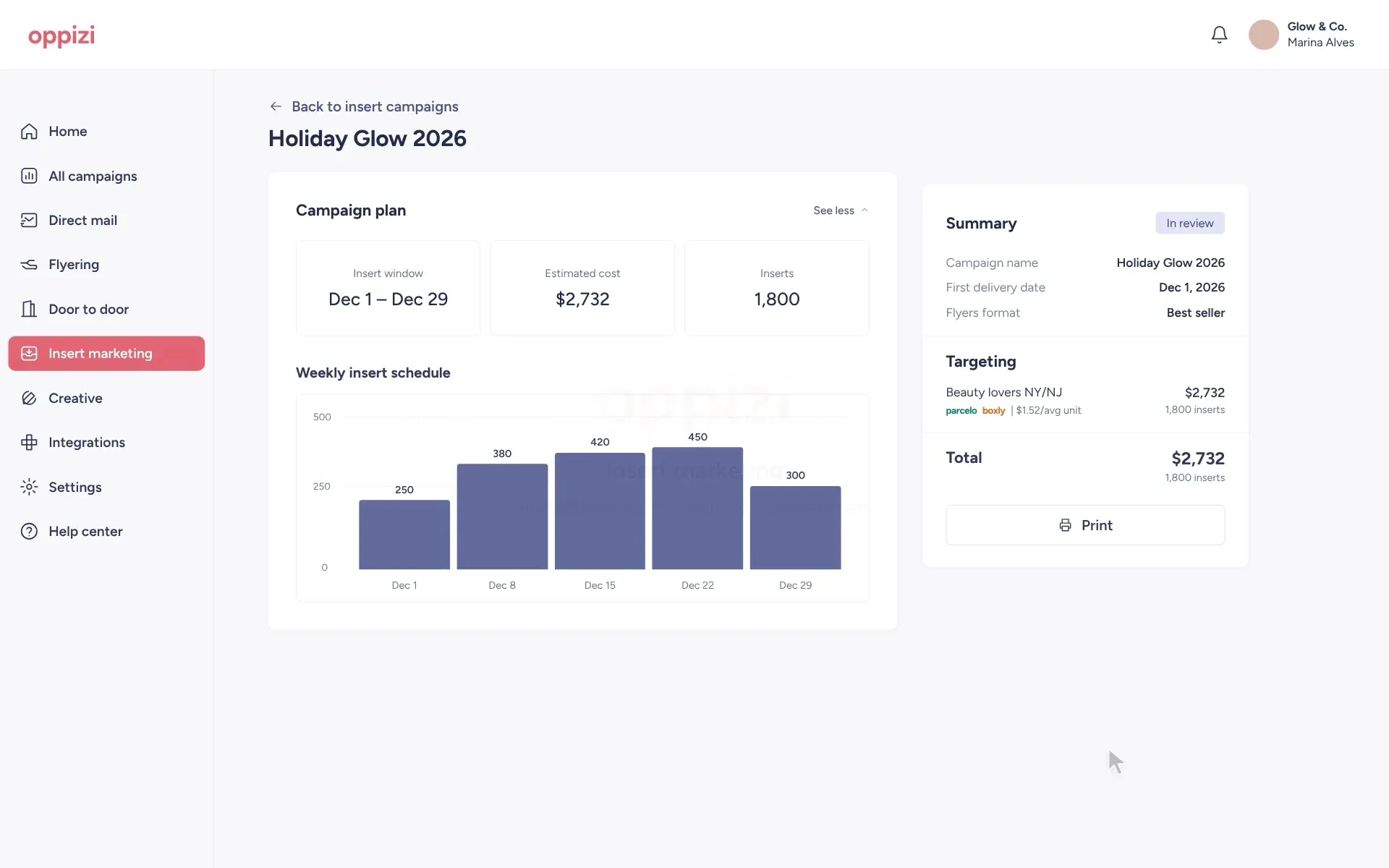
In a few weeks, the prototype got sales moving early, the channel became official and the teams started discussing the same product.
Selling before the product
With a clickable prototype, sales presented the channel and negotiated with clients and partners while the product was still being built.
An official channel in several countries
Today Insert marketing is one of Oppizi's official channels, offered in several countries, with affiliates like JCPenney, Chewy and Ulta Beauty.
A shared vision
Leadership's vision became a flow with explicit rules. Engineering, operations and sales started discussing the same product, and the pilot decisions were documented.
Time
From concept to the advertiser experience handoff in a few weeks, in 2024, when generating prototypes with AI wasn't common practice yet.
Key learnings
In new products, the first designed version is worth more than any document: it's what gets everyone discussing early, around something concrete.
Knowing the company's other flows let us move fast, reusing what already worked. Design is also knowing what doesn't need to be reinvented.